
Aegaea

Quick links

↑ ↓ to choose · Enter to open · Esc to closeSearch stays in your browser.

Technical Insight4 min readDouglas Swinbanks

Glasgow City Council – Bespoke Flood Risk Assessment and Design Requirements

It has now been two years since the adoption of the National Planning Framework 4 (NPF4)– the spatial strategy for Scotland which replaced NPF3 and the Scottish Planning Policy (SPP).
Glasgow City Council – Bespoke Flood Risk Assessment and Design Requirements
On this page

It has now been two years since the adoption of the National Planning Framework 4 (NPF4)– the spatial strategy for Scotland which replaced NPF3 and the Scottish Planning Policy (SPP).

When it comes to flood risk, NPF4 should generally be compatible with the requirements set out in the local development plan for the corresponding local authority.

Even though the NPF4 is set on a national level, Local Development Plans and their associated guidance documents are considered alongside the NPF4 to inform planning decisions. Some councils have requirements related to flood risk, which go beyond the requirements set out in the NPF4.

However, there are still some unique flood risk criteria in place in areas across Scotland, including Glasgow City Council.

A scenic view of Glasgow with the prominent red sandstone towers of the Kelvingrove Art Gallery and Museum rising above the tree-lined landscape.

Glasgow’s Unique Development Pressures

Glasgow City is the council region with the largest population, as per the latest data from 2023. Glasgow City is a dynamic and rapidly changing place, which attracts a large number of international and domestic students, choosing to settle and start their career in the City of Glasgow. It is no surprise that the consequences of this trend in terms of planning are increased demand for housing, student accommodation and pressure to put industrial land to good use to accommodate these requirements.

Aegaea have provided flood risk and drainage support to many projects within the Glasgow City Council Region, ranging from residential, student accommodation, commercial and BESS / renewable energy developments. Although each project broadly follows the principles set out in NPF4, there are some bespoke and unique requirements specific to GCC that need to be adhered to as part of a valid application.

Bespoke FRA Requirements

Glasgow City Council’s SG8 Water Environment Guidance published in 2017 (and still adhered to) outlines the needs for properties to be assessed against flood events with certain return periods, based on the nature of the development.

This is outlined in the Council’s Flood risk Framework, which is present in page 9 of the guidance.
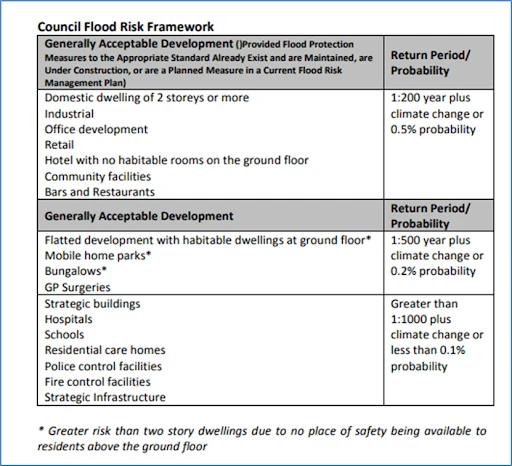
A table titled "Council Flood Risk Framework" showing acceptable development types and corresponding flood return periods or probabilities. It is divided into two sections of "Generally Acceptable Development." The first section includes domestic dwellings of 2 storeys or more, offices, retail, hotels with no habitable rooms on the ground floor, community facilities, and bars/restaurants, with a return period of 1:200 years plus climate change or 0.5% probability. The second section includes flatted developments with ground floor habitable dwellings, mobile home parks, bungalows, and GP surgeries, with a return period of 1:500 years plus climate change or 0.2% probability. It also lists critical infrastructure (e.g., hospitals, schools, emergency services) requiring a return period greater than 1:1000 years plus climate change or less than 0.1% probability. A note indicates greater risk for single-storey dwellings due to lack of upper-floor refuge.

Generally, across Scotland, residential developments which have habitable dwellings, flats or sleeping accommodation at ground level do not need to be assessed up to the 1 in 500 + Climate Change flood extents, and are generally assessed against the Flood Risk Area (i.e. the 1 in 200 year (plus climate change) event. This is a bespoke Glasgow criteria.

SEPA’s flood maps have been prepared on a strategic level, and do not include these bespoke flood risk extents such as the flood risk extents for 1 in 500y+CC and 1 in 1000y+CC fluvial flood events.

Therefore, it is important to remember that your development includes an overnight accommodation with habitable dwellings at ground floor level, or a development which the council consider as a “Strategic Infrastructure” you will likely need a bespoke hydraulic modelling to assess against the 1 in 500y+CC or 1 in 1000y+CC fluvial flood event. This can also have an impact on your proposed finished floor levels, which generally need to be set a minimum of 600mm above the design flood level

It is also worth remembering that Glasgow City Council require an independent check of any FRA or DIA before submission. A full list of councils requiring FRA or DIA independent certifications is provided here:

https://aegaea.com/about-us/news/flood-risk-assessment-independent-certifications-in-scotland/

Talk to the experts

Our experience in the Glasgow City Council region puts us in a great position in assisting you with your development, and please do not hesitate to get in touch if you want to discuss anything flood related in Scotland’s largest city!

Written and reviewed by

Douglas Swinbanks

Principal Flood Risk and Drainage Engineer, Scotland · MEng (Hons) MCIWEM

I am a Member of the Chartered Institution of Water and Environmental Management (CIWEM), a Principal Flood Risk Engineer and Hydrologist based in Edinburgh, and I lead Aegaea's Scotland branch.

View profile →LinkedIn ↗

↑ Back to top

Insights

Talk to us about your project

If this raises questions about your own site, we can help you work through them. Share your plans and any comments from the council, and we’ll send a free, no-obligation quote.

Newsletter

Stay ahead of flood risk and planning changes

  • Policy and flood map changes, explained in plain English
  • Practical guidance for your next planning application
  • New projects and lessons from our consultants

No spam. Unsubscribe any time. By signing up, you agree to receive our newsletter and occasional updates. See our privacy policy for how we use your data.

Read the latest update →

Preview: signup not connected yet.