What has happened?
On 23 November 2026, First Secretary of State Louise Haigh used her keynote speech to the CBI’s annual conference to set out the government’s plans to reform arm’s-length bodies. The government will look at each body’s functions and ask what should be devolved, what can be dissolved and what could be delivered by government departments.
That process has already begun with four bodies: the Environment Agency, Natural England, Ofwat and the Drinking Water Inspectorate. Both the Environment Agency and Natural England are statutory consultees on planning applications.
Haigh also argued that decisions “intrinsic to the fabric of a place” should be made locally rather than in Whitehall. On housing, the government will set out steps over the coming weeks to make the system faster, reduce uncertainty and tackle costs.
No decisions have been made. No timetable has been given, and the government has not said where any of these bodies’ work would go.
What does it mean for flood risk assessments?
For now, nothing changes. Planning applications are decided under the same national policy, and a flood risk assessment still needs the same evidence. The Environment Agency’s role in that evidence is large, which is why any change matters to our clients:
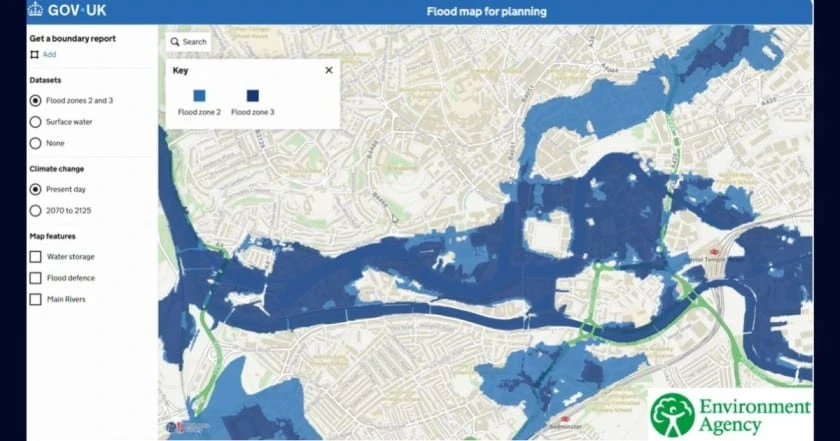
- Flood mapping. The Flood Map for Planning is the starting point for most assessments, and it is the Environment Agency’s.
- Flood data. Detailed flood levels and model outputs come from Environment Agency data requests, which have a statutory 20 working day turnaround.
- Planning consultation. Councils consult the Agency on development within 20 metres of a main river, and on many applications in flood zones.
- Permits. Work within 8 metres of a main river, flood defence or culvert (16 metres if tidal) may need a flood risk activity permit from the Agency.
Natural England’s work touches planning in a different way, through advice on protected sites and nature.
If these functions move to a government department, to local leaders or to a new body, the practical questions are who answers data requests and how quickly, who is consulted on applications, and who issues permits. Any handover could affect timescales, so it is worth allowing for this in programmes once details are known.
What we are doing
We are monitoring this and will update this article as soon as there is more detail.
If you have a scheme in planning or in the pipeline, talk to us or call 020 8156 6076. We can tell you what your site needs and build any Environment Agency data request into your programme early.
Source
- GOV.UK: CBI Keynote Speech - The Business Case for Public Control, Louise Haigh, 23 November 2026