
What is nutrient neutrality?
Nutrient neutrality is a way of showing that a development will not add to nitrogen or phosphorus pollution reaching a protected Habitats Site in England. Where those sites are already in poor condition because of nutrients, a council cannot normally grant permission under the Habitats Regulations unless it is sure, after an appropriate assessment, that the development will not adversely affect the integrity of the site. Natural England’s advice of 16 March 2022 (NE785) advised councils in the affected catchments to consider nutrient neutrality “as a potential solution”.
Too much nitrogen and phosphorus causes eutrophication - algal growth that strips oxygen from rivers, lakes and estuaries. Most of the extra load from new housing comes from wastewater; some comes from changes in land use.
Where does nutrient neutrality apply in 2026?
Nutrient neutrality applies in 27 catchments in England. GOV.UK lists them on its nutrient neutrality calculators page, last updated on 11 March 2026. Since the March 2022 advice, no catchments have been added: a 2024 review reduced or redrew seven catchment boundaries, phosphorus neutrality was removed for Poole Harbour, and in February 2026 the River Eden and River Camel areas were reduced.
The table shows, for each catchment, which nutrient applies, whether the 2030 wastewater assumption can apply, whether Natural England has said it will prepare an Environmental Delivery Plan (EDP), and whether Natural England sells credits there.
Nutrient neutrality catchments in England and their status, October 2026 (GOV.UK and Natural England)
| Catchment | Nutrient | 2030 sewage-works upgrade counted? | EDP | Natural England credits |
|---|---|---|---|---|
| Chesil and the Fleet | N and P | No | Not planned | No |
| Esthwaite Water | P | No | Not planned | No |
| Hornsea Mere | N and P | No | Not planned | No |
| Lindisfarne | N | No | Not planned | No |
| Oak Mere | N and P | No | Not planned | No |
| Peak District Dales | P | No | Planned | No |
| Poole Harbour | N | Yes | Planned | Yes |
| River Avon | P | Yes | Planned | No |
| River Axe | P | Yes | Planned | No |
| River Camel | P | Yes | Planned | No |
| River Clun | N and P | No | Planned | No |
| River Derwent and Bassenthwaite Lake | P | Yes (part) | Not planned | No |
| River Eden | P | Yes | Planned | No |
| River Itchen | P | Yes | Planned (within Solent) | No |
| River Kent | P | Yes (part) | Planned | No |
| River Lambourn | P | Yes | Planned | No |
| River Lugg | P | No | Planned | No |
| River Mease | P | Yes | Planned | No |
| River Wensum | P | Yes | Draft out for consultation (Norfolk) | No |
| Roman Walls Loughs | P | No | Not planned | No |
| Rostherne Mere | N and P | No | Not planned | No |
| Solent | N | Yes | Planned | No |
| Somerset Levels and Moors | P | Yes | Planned | No |
| Stodmarsh | N and P | Yes | Planned | No |
| Teesmouth | N | Yes | Planned | Yes |
| The Broads | N and P | Yes (part) | Draft out for consultation (Norfolk; Yare and Bure only) | No |
| West Midlands Mosses | N and P | No | Not planned | No |
N = nitrogen, P = phosphorus. “2030 sewage-works upgrade counted?” Yes means the catchment is designated nutrient sensitive, so the assumption can apply to development connected to a designated works (see below). “Planned” means Natural England notified the Secretary of State on 19 December 2025 that it will prepare an EDP; none had been made by 17 October 2026.
Map of the nutrient neutrality catchments in England (Natural England boundaries, updated 15 May 2026)
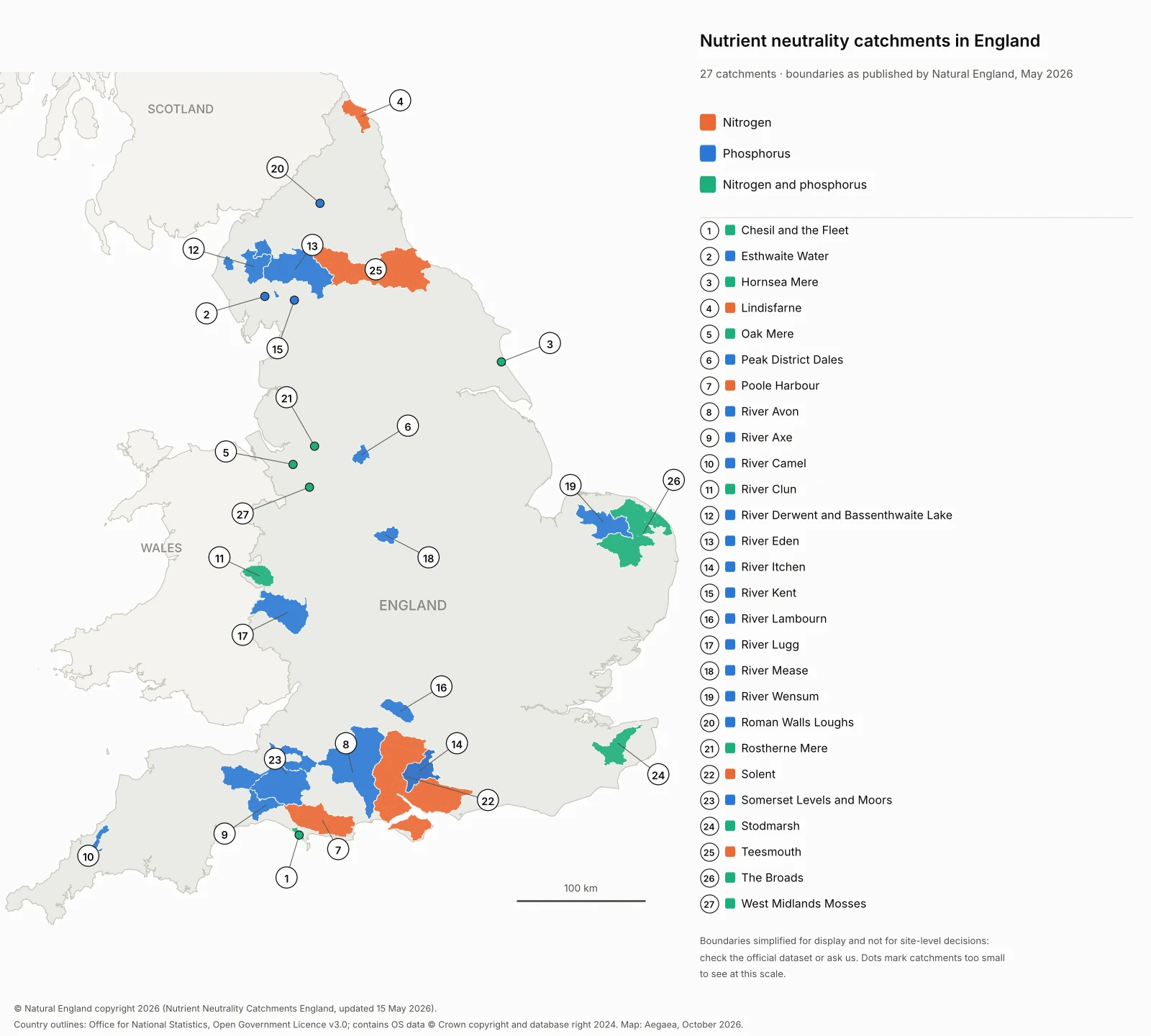
To check whether a specific site is inside a catchment, enter its postcode in our interactive map, use Natural England’s official nutrient neutrality catchments dataset, or ask us. The map shows boundaries simplified for display, so for a site near a boundary check the official dataset.
Which councils are affected?
Natural England’s 2022 advice named the councils covering each catchment. Several were abolished on 1 April 2023, so the names in that letter are out of date. The table maps the councils named in 2022 onto the authorities in place today. This is our mapping, because Natural England has not republished the list. For the River Eden and River Camel, whose boundaries changed in February 2026, we checked the revised boundaries against current planning authority boundaries. Authorities we have added that were not named in 2022 are marked *.
Councils covering each catchment, with current names (Aegaea mapping of Natural England’s March 2022 advice)
| Catchment | Councils (current names) |
|---|---|
| Poole Harbour | Dorset Council; BCP Council |
| The Solent | Basingstoke and Deane; Chichester; East Hampshire; Eastleigh; Fareham; Gosport; Havant; Isle of Wight; New Forest District; New Forest National Park; Portsmouth; South Downs National Park; Southampton; Test Valley; Wiltshire; Winchester |
| River Itchen | Basingstoke and Deane; East Hampshire; Eastleigh; Winchester |
| River Avon | BCP; Dorset; New Forest District; New Forest National Park; Test Valley; Wiltshire |
| River Camel | Cornwall Council (the revised boundary lies wholly within Cornwall) |
| Stodmarsh | Ashford; Canterbury; Dover; Folkestone and Hythe; Maidstone; Swale |
| River Lugg | Herefordshire Council; Malvern Hills |
| Somerset Levels and Moors | Somerset Council; Dorset; Exmoor National Park; Mid Devon; Wiltshire |
| River Axe | Somerset Council; Dorset; East Devon |
| Chesil and the Fleet | Dorset Council |
| Esthwaite Water | Westmorland and Furness (named as South Lakeland in 2022); Lake District National Park* |
| Hornsea Mere | East Riding of Yorkshire |
| Lindisfarne | Northumberland |
| Oak Mere | Cheshire West and Chester |
| Peak District Dales | Derbyshire Dales; High Peak; Peak District National Park |
| River Clun | Herefordshire; Shropshire |
| River Derwent and Bassenthwaite Lake | Cumberland; Westmorland and Furness; Lake District National Park |
| River Eden | Westmorland and Furness; Lake District National Park; Yorkshire Dales National Park*; Cumberland (a small area). The revised February 2026 boundary no longer covers Durham, Northumberland, Northumberland National Park or North Yorkshire (formerly Richmondshire), which the 2022 advice named |
| River Kent | Westmorland and Furness; Lake District National Park |
| River Lambourn | Swindon; Vale of White Horse; West Berkshire; Wiltshire |
| River Mease | East Staffordshire; Hinckley and Bosworth; Lichfield; North Warwickshire; North West Leicestershire* (leads the Local Nutrient Mitigation Fund for the Mease) |
| River Wensum and The Broads | Breckland; Broadland; South Norfolk; King’s Lynn and West Norfolk; North Norfolk; Norwich; Great Yarmouth; Broads Authority (the draft Norfolk EDP lists all of these except Great Yarmouth) |
| Roman Walls Loughs | Northumberland; Northumberland National Park |
| Rostherne Mere | Cheshire East |
| Teesmouth | Darlington; Durham; Hartlepool; Middlesbrough; Redcar and Cleveland; Stockton-on-Tees; North York Moors National Park; North Yorkshire; Westmorland and Furness |
| West Midlands Mosses | Cheshire East; Cheshire West and Chester |
The 2023 changes: Allerdale, Carlisle and Copeland were replaced by Cumberland Council; Eden, South Lakeland and Barrow by Westmorland and Furness Council; Hambleton and Richmondshire became part of North Yorkshire Council; and Somerset Council replaced Somerset County Council and the four districts (Mendip, Sedgemoor, Somerset West and Taunton, and South Somerset).
Which developments are caught?
Nutrient neutrality catches development in an affected catchment that results in a net increase in the population served by a wastewater system. In practice that means any net increase in overnight accommodation, plus tourism attractions:
- new homes, including a single dwelling;
- care homes and student accommodation;
- hotels, holiday lets and other tourist accommodation;
- permitted development that creates new overnight accommodation, including prior approvals and certificates of lawfulness (Class Q barn conversions to homes are a common example);
- tourism attractions, which Natural England’s advice names alongside tourist accommodation.
Other business and commercial development that does not involve overnight accommodation will generally not need a nutrient budget, unless it has other effects on water quality.
If you can connect to the mains sewer, you should. Natural England’s advice is that development should connect to the public foul sewer wherever that is reasonable, and that nutrient concerns should not push schemes onto package treatment plants. Where a package treatment plant or septic tank is used, the calculator guidance expects a comprehensive maintenance regime.
What is the 2030 wastewater assumption?
The Levelling-up and Regeneration Act 2023 requires water companies to upgrade larger wastewater treatment works in designated catchments so that treated effluent meets 10 mg/l total nitrogen where the catchment is designated for nitrogen, and 0.25 mg/l total phosphorus where it is designated for phosphorus, generally by 1 April 2030. It also requires councils, when assessing a planning application, to assume that a designated works serving the development will meet the relevant limit from its upgrade date.
The assumption can make a large difference to a nutrient budget, but it reduces the wastewater load only from the upgrade date. Homes occupied before then still need mitigation for the higher pre-upgrade load, so the calculator gives two figures, before and after the upgrade, and both must be mitigated. Natural England’s calculators build this in automatically.
The assumption does not apply:
- in the 11 catchments that are not designated nutrient sensitive (shown as “No” in the table above);
- where the development drains to a package treatment plant or septic tank;
- where the receiving works is too small to be designated — works below 2,000 population equivalent are exempt by default.
In the Somerset Levels and Moors the statutory upgrade date is 16 May 2031, although the water company has committed to 1 April 2030.
How is a nutrient budget calculated?
A nutrient budget is calculated with Natural England’s nutrient neutrality calculator for the relevant catchment. Each catchment has its own spreadsheet on GOV.UK (the Wensum shares The Broads and Wensum SACs calculator); there is no single national version. The calculator follows Natural England’s generic methodology in five worksheets:
- Wastewater — the extra nitrogen or phosphorus from the development’s wastewater, using a default occupancy of 2.4 people per dwelling (other overnight accommodation is entered as units).
- Current land use — the nutrient load from the site as it is now, such as farmland.
- Future land use — the load from the site once developed, including gardens and open space.
- SuDS removal — any reduction from sustainable drainage features that remove nutrients.
- Final budget — the net change, multiplied by 1.2 to add a 20% precautionary buffer.
The result is the annual load, in kilograms of nitrogen or phosphorus, that must be mitigated. For a mains-connected house in a designated catchment, the post-upgrade budget is usually lower, but mitigation is still needed for any period before the works are upgraded. On a package treatment plant or septic tank the 2030 assumption does not apply, so the budget depends on the system: Natural England’s advice is that systems discharging to ground through a drainage field generally pose little threat, depending on location, design and maintenance, while systems discharging to a watercourse usually carry a higher load.
How can you mitigate nutrient pollution?
There are four main routes. Which suits a scheme depends on its size, its catchment and how quickly it needs to start.
Ways to mitigate nutrient pollution (summary)
| Route | How it works | Best suited to |
|---|---|---|
| On-site measures | Reduce the budget through land use change on the site or nutrient-removing SuDS | Larger sites with land to spare |
| Bespoke off-site mitigation | Secure land use change, wetlands or treatment upgrades in the same catchment, upstream of the protected site | Larger schemes, or where no credit scheme exists |
| Nutrient credits | Buy credits from Natural England (Tees and Poole Harbour), a council scheme or a private scheme | Small and medium schemes that need certainty quickly |
| Nature Restoration Levy | Pay a levy under a made Environmental Delivery Plan instead of providing mitigation | Housing in a catchment with a made EDP — none yet |
Natural England credits. Natural England’s Nutrient Mitigation Scheme, launched in the Tees catchment in March 2023, now sells credits continuously in two catchments, the Tees and Poole Harbour. One credit offsets 1 kg of nitrogen, so the number of credits a scheme needs depends on its nutrient budget, and a single home may need more than one. In the Dorset Council area (not BCP), Dorset Council also offers short-term (“temporary”) credits for the pre-2030 period.
Council and private schemes. Several councils run their own schemes, many funded through the government’s Local Nutrient Mitigation Fund. For example, Somerset Council runs a phosphorus credit scheme in the River Tone catchment and lists third-party schemes it does not endorse, and Eastleigh Borough Council sells nitrate credits for parts of the Solent catchment and phosphate credits for parts of the River Itchen catchment. Somerset Council warns that third-party credits are bought at the applicant’s own risk; check that the council will accept any private credits before buying.
What credits cost. Credit prices vary across the country, between schemes and over time. If credits are required, the private supplier or local authority (or Natural England, for its own scheme) should be contacted to confirm costs.
What changes with the Nature Restoration Fund?
The Planning and Infrastructure Act 2025, which received Royal Assent on 18 December 2025, created Environmental Delivery Plans (EDPs). An EDP is prepared by Natural England and made by the Secretary of State. Where one is made, a developer can pay a Nature Restoration Levy instead of providing their own mitigation; Natural England then delivers the conservation measures. The Secretary of State can only make an EDP if its measures materially outweigh the harm from the development it covers.
On 19 December 2025 Natural England said it would prepare 16 nutrient EDPs. The first draft covers the Yare and Bure parts of the Broads Special Area of Conservation, Broadland Ramsar and the River Wensum SAC in Norfolk. It went out for consultation on 17 September 2026 and closes at 9:29am on 27 October 2026. It lists six planning authorities: Breckland, the Broads Authority, King’s Lynn and West Norfolk, North Norfolk, Norwich, and South Norfolk and Broadland. Great Yarmouth is not among them. The draft proposes:
- a levy of £2,675 per house or flat, plus indexation;
- coverage of up to 15,780 homes over ten years;
- that it applies to dwellinghouses, including flats, only.
Using an EDP will usually be voluntary. Developers can still mitigate through the existing route under the Habitats Regulations. Because the Norfolk draft applies to dwellings only, hotels, care homes, student housing and holiday accommodation that is not a dwellinghouse (such as lodges, cabins and caravans) would still need bespoke mitigation or credits there.
Is nutrient neutrality being scrapped? No. At 17 October 2026 it still applies in all 27 catchments. EDPs offer an alternative way to comply, not an exemption, and none has yet been made.
Nutrient pollution in Wales
Wales does not use Natural England’s nutrient neutrality advice. Natural Resources Wales assessed nine Welsh river Special Areas of Conservation against tighter phosphorus targets and in January 2021 reported that over 60% of their water bodies were failing, which limits development that would add phosphorus. The Welsh Government publishes separate planning guidance for development in phosphorus-affected SAC river catchments (August 2025).
How Aegaea can help
If you are building one or a few homes, we will confirm whether your site is in a catchment, run the nutrient budget, and set out the cheapest compliant route — mains connection, credits or on-site measures.
If you are a housebuilder, planning consultant or care or student housing developer, we prepare nutrient budgets and nutrient neutrality statements for planning and prior approval, model SuDS nutrient removal alongside your surface water drainage strategy, compare credits, levy and bespoke mitigation on cost and timing, and work with the council and Natural England to get the mitigation accepted.
Send us your site address and the number of units. We’ll tell you whether nutrient neutrality applies and which mitigation route fits. Contact us or call 020 8156 6076.