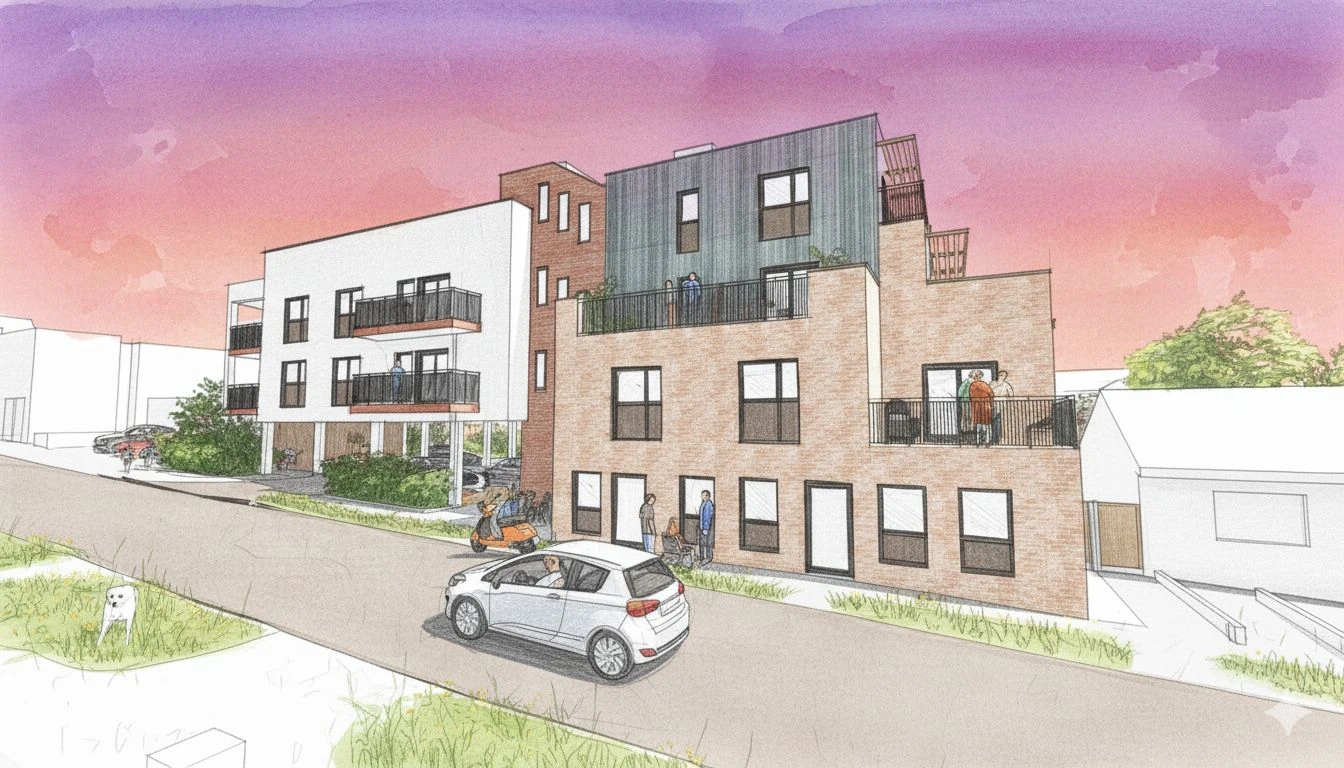
Does Permitted Development require a Flood Risk Assessment?
It depends on the permitted development rights. Some rights include “flooding risks” as a matter the council must approve before work starts; others do not. Where flooding is a prior approval matter and the site is in Flood Zone 2 or 3, or in a Flood Zone 1 area with critical drainage problems, an FRA must accompany the application. The table sets out the main rights in England.
Permitted development rights and flooding prior approval (GPDO 2015, Schedule 2)
| Permitted development right (GPDO 2015, Schedule 2) | Flooding a prior approval matter? | Flood risk assessment required? |
|---|---|---|
| Part 3 Class MA — Class E (commercial, business and service) to homes | Yes: “flooding risks in relation to the building” (MA.2(2)(c)) | Yes, in Flood Zone 2 or 3, or Flood Zone 1 with critical drainage problems |
| Part 3 Class Q — agricultural and former agricultural buildings to homes | Yes: “flooding risks on the site” (Q.2(1)(d)) | As above |
| Part 3 Class G — Class E to a mixed use with up to 2 flats | Yes (G.1(d)(ii)) | As above |
| Part 3 Class M — launderette, betting office, pay day loan shop or hot food takeaway to homes (up to 150 m²) | Yes (M.2(1)(c)) | As above |
| Part 3 Class N — amusement arcade or casino to homes (up to 150 m²) | Yes (N.2(1)(c)) | As above |
| Part 3 Class R — agricultural buildings to a flexible commercial use, where the cumulative floor space exceeds 150 m² | Yes (R.3(1)(b)(iv)) | As above |
| Part 3 Class S — agricultural buildings to a state-funded school or nursery | Yes (S.2(1)(b)(iv)) | As above |
| Part 3 Class T — commercial buildings to a state-funded school or nursery | No | Not required by the GPDO |
| Part 20 — new homes on top of existing buildings (Classes A and AA to AD), and demolition and rebuild as homes (Class ZA) | Yes | Yes, on the same triggers (Part 20, paragraph B) |
| Part 1 — householder extensions, loft conversions, outbuildings and hard surfaces | No | Not required by the GPDO |
| Part 3 Class O — offices to homes | Closed: applications had to be made by 31 July 2021 | Use Class MA instead |
Class O, Use Class A and B1(a) are out of date. Shops, financial and professional services, cafés and offices (the former Use Classes A1, A2, A3 and B1) became part of Class E on 1 September 2020. Office-to-residential conversions now use Class MA. Class O remains printed in the Order, but it is closed to new applications after 31 July 2021.
Class MA: commercial buildings to homes
Class MA permits a change of use from Class E (commercial, business and service) to Class C3 homes, subject to prior approval. Since 5 March 2024 (S.I. 2024/141) it has had no floorspace cap and no requirement for the building to be vacant. The building must have been in Class E use, or the equivalent former use classes, for a continuous period of at least two years before the application (MA.1(1)(b)), and development must be completed within three years of the prior approval date.
Class MA excludes, among others, listed buildings, scheduled monuments, sites of special scientific interest, safety hazard and military explosives areas, National Parks, the Broads, areas of outstanding natural beauty and World Heritage Sites. There is no flood-zone exclusion. Instead, “flooding risks in relation to the building” is a prior approval matter (MA.2(2)(c)), and an FRA is required where the Environment Agency must be consulted (MA.2(4)(a)).
For a Class MA conversion in a flood zone, the FRA typically addresses:
- whether the ground floor is suitable for bedrooms or self-contained flats, given the design flood level;
- finished floor levels and any refuge above the flood level;
- safe access and escape from the building during a flood, including from upper-floor flats;
- flood resistance and resilience measures that can be built into the conversion;
- a Flood Warning and Evacuation Plan (FWEP) where residual risk remains.
Class Q: agricultural buildings to homes
Class Q was substituted on 21 May 2024 (S.I. 2024/579). It now allows agricultural buildings, and former agricultural buildings, to be converted to homes, subject to prior approval:
- up to 10 homes and ** 1,000 m²** of homes in total within the original limits of the agricultural unit;
- no home larger than 150 m²;
- a single-storey rear extension of up to 4 m, only on a hard surface that was in place on 24 July 2023 (or has been for at least 10 years);
- building operations limited to windows, doors, roofs, exterior walls and services, and the partial demolition needed for them;
- the site must have been part of the agricultural unit on 24 July 2023, or for at least 10 years if it joined the unit later. Former agricultural buildings have their own date tests (Q.1(b)) and must not have been used for any non-agricultural purpose since leaving the unit.
Class Q does not apply on article 2(3) land (such as conservation areas and National Parks), sites of special scientific interest, safety hazard or military explosives areas, scheduled monuments or listed buildings. The building must be capable of meeting the nationally described space standard and have suitable existing access to a public highway. There is no flood-zone exclusion. “Flooding risks on the site” is a prior approval matter (Q.2(1)(d)).
Two features of Class Q matter for flood risk. The flooding matter is about the site, not only the building, so the curtilage, including gardens and on-site access, is part of the assessment; safe escape beyond the site is assessed under NPPF Policy F7. And Planning Practice Guidance makes a related point on the separate location and siting matter (paragraph 109): a building being somewhere the council would not normally allow a new home “is not a sufficient reason for refusing prior approval”. In our view the flood question works the same way: the issue is whether the flood risk on the site can be made acceptable.
Worked example: a barn conversion in Flood Zone 3a
All applications are now made under the current Class Q, as substituted in May 2024.
Worked example: a barn conversion in Flood Zone 3a
A farmer plans to convert a steel-framed barn into three homes under Class Q: a change of use, with the building works needed to convert it (Classes Q(a) and Q(c)). The barn is in Flood Zone 3a.
- Prior approval and consultation. Flooding risks on the site are a prior approval matter, and because the site is in Flood Zone 3, the council must consult the Environment Agency. A site-specific FRA must accompany the application.
- Sequential test. The proposal is a change of use, so the sequential test should not be required (NPPF Policy F5(2)(c)(iii); December 2024 NPPF paragraph 176), and the exception test is not needed either (F6(2)(a)). If the works went beyond what Class Q allows and amounted to a rebuild, the council could treat the scheme as a new dwelling, and the test would then apply. An extension under Class Q(b) is not itself a change of use.
- Compatibility. Homes are more vulnerable development. Table 3 of Annex F does not rule them out in Flood Zone 3a. If the barn were in Flood Zone 3b, the functional floodplain defined in the council’s strategic flood risk assessment, the conversion would conflict with NPPF Policy F6(1)(a), under which more vulnerable uses there “should be refused”. The council must have regard to that policy, so prior approval would be likely to be refused. Check the SFRA first: Flood Zone 3b is not shown on the Flood Map.
- Safety. The FRA sets the design flood level with climate change and shows finished floor levels above it with an allowance for freeboard, safe access and escape, a flood warning and evacuation plan, and resilient construction.
- Flood risk elsewhere. The FRA confirms the conversion does not reduce floodplain storage or increase runoff, for example through changes to ground levels.
This is an illustrative scenario. Every real site needs its own assessment.
Can I build an extension under permitted development in a flood zone?
Usually, yes. Householder permitted development rights in Part 1 of the GPDO, such as rear extensions and outbuildings, contain no flood-zone restriction and no flooding prior approval. The one drainage condition is for hard surfaces: a new or replaced hard surface of more than 5 m² between the house and the road must be porous, or drain to a permeable area within the property (Class F).
Two exceptions are worth checking. A council can remove specific permitted development rights by an Article 4 direction “where such development could impact on the risk of flooding” (Planning Practice Guidance, paragraph 053). And if your extension needs planning permission, it is exempt from the sequential test as householder development, but a flood risk assessment is still needed in Flood Zone 2 or 3. See our minor developments page.
How do I check whether my site is in a flood zone?
In England, use the Environment Agency’s Flood Map for Planning. It is free. You draw your site boundary and it returns the flood zone, along with surface water and climate change data. Light blue is Flood Zone 2 and dark blue is Flood Zone 3. The flood zones show river and sea flooding only, and the map does not separately show Flood Zone 3b, the functional floodplain, which the council identifies in its strategic flood risk assessment.
In Wales, use the Flood Map for Planning published by Natural Resources Wales. In Scotland, use SEPA’s flood maps. Permitted development rights in Wales and Scotland are set by separate orders; this page covers England.
When does a prior approval application need a flood risk assessment?
Paragraph W of Part 3 of the GPDO sets out the procedure. Where the application relates to prior approval as to flooding risks, the council “must consult the Environment Agency where the development is - (a) in an area within Flood Zone 2 or Flood Zone 3; or (b) in an area within Flood Zone 1 which has critical drainage problems and which has been notified to the local planning authority by the Environment Agency …” (W(6)). And wherever W(6) requires the Environment Agency to be consulted, the application must be accompanied by “a site-specific flood risk assessment” (W(2)(e)).
Planning Practice Guidance (paragraph 053) puts it the same way: “applications for prior approval in areas of flood risk must be accompanied by a site-specific flood risk assessment”.
Flood Zone 1 sites at risk from other sources. If your building is in Flood Zone 1 and not in a notified critical drainage area, the GPDO does not require an FRA, but flooding risks are still a prior approval matter. The council can ask for “such information as the authority may reasonably require”, including assessments of risks and how they will be mitigated (W(9)). Without enough information, the council may be unable to approve the flooding matter. Where the Flood Map for Planning shows surface water risk, or the building has flooded before, a short flood risk note usually avoids that.
What does the council consider on flood risk?
Prior approval is not a planning application. Planning Practice Guidance describes it as “a light-touch process”, and the council “cannot consider any other matters” than those the GPDO specifies. On flooding, paragraph W(10)(b) requires the council to “have regard to the National Planning Policy Framework …, so far as relevant to the subject matter of the prior approval, as if the application were a planning application”.
Which NPPF? The GPDO defines the NPPF by date. Since 9 April 2026 the definition has referred to the December 2024 Framework. S.I. 2026/1056 changes it to the ** August 2026** Framework with effect from ** 21 October 2026**, so prior approval decisions made from that date are made against Chapter 18 and Annex F of the new NPPF. Both versions exempt changes of use from the sequential test: the December 2024 Framework in paragraph 176 and footnote 62, and the August 2026 Framework in Policy F5(2)(c)(iii).
Under the August 2026 NPPF, the policies most relevant to flooding risks are:
- Policy F4: a site-specific FRA for all proposals in Flood Zones 2, 3a and 3b, proportionate to the scale, nature and location of the development.
- Policy F5(2)(c)(iii): changes of use are exempt from the sequential test, “other than changes of use to a caravan, camping or chalet site, or to a mobile home or park home site”. Under Policy F6(2)(a), the exception test then does not apply either.
- Policy F6(1)(a): in Flood Zones 2, 3a and 3b, proposals “should be refused if the use is incompatible with the risk from river or sea flooding, as set out in Annex F, table 3”. Homes are more vulnerable development, which table 3 says should be refused in Flood Zone 3b, the functional floodplain.
- Policy F7: development at risk from any form of flooding “should be refused unless” the most vulnerable parts are in the lowest-risk areas of the site, it will be safe for its lifetime, with residual risk managed, safe access and escape as part of an agreed emergency plan, flood resistance and resilience, and no increase in flood risk elsewhere.
Converting most commercial or agricultural buildings to homes raises their vulnerability. Offices, shops and agricultural buildings are less vulnerable under Annex F, table 2; dwelling houses are more vulnerable. Planning Practice Guidance (paragraph 052) notes that older buildings “may not previously have been subject to a flood risk assessment”, or that the flood risk may have changed. In our experience, an FRA prepared for the building’s previous use will rarely be enough.
Does the sequential test apply to prior approval?
The sequential test should not be required for a change of use made through prior approval, other than to a caravan, camping or chalet site, or a mobile home or park home site. Both the December 2024 and the August 2026 NPPF exempt such changes of use from the test, and the council applies the NPPF only “so far as relevant to the subject matter of the prior approval, as if the application were a planning application” (paragraph W(10)(b)). Planning Practice Guidance (paragraph 014) also says changes of use are “not normally subject to the Sequential or Exception tests”. Where the sequential test is not required, the exception test is not required either (Policy F6(2)(a)).
Two limits apply. The exemption covers the change of use, not new building: if the works go beyond what the class allows and amount to a rebuild, the council can treat the scheme as a new dwelling, and the sequential test then applies. And the exemption does not override Annex F, table 3: a change of use to homes in Flood Zone 3b still conflicts with Policy F6(1)(a).
How Aegaea can help
If you are a homeowner, farmer or landowner, we will check which permitted development route applies, whether flooding is a prior approval matter, and whether the council will need an FRA. If it does, we produce one proportionate to the conversion, typically in 5 to 10 working days once we have the data.
If you are a developer, agent or architect, we prepare FRAs for Class MA, Class Q and Part 20 prior approvals, advise on layouts that keep sleeping accommodation above the flood level, and respond to Environment Agency consultation comments. We work with you before the application, when design changes are cheapest.
Every Aegaea report is reviewed and signed off by a Chartered member of CIWEM.